

Where To Find Alien Rave Makeup
Book 2, Outcome 1, #5 - 2019
Alien Beauty: Posthuman Re-Imaginings
By Presley mills
https://doi.org/10.38055/FS020105
Abstract:
In the fall of 2018 WGSN (World Global Style Network) ran a written report on the emerging "alien dazzler" trend, which they defined as "an otherworldly aesthetic inspired by extraterrestrial life forms … signifying a new rebellious attitude towards quintessential beauty norms" (Bailey). Instagram is one of the largest platforms to correspond the trend of alien dazzler, presented by a thriving community of makeup artists pushing the boundaries of conventional dazzler practices. These artists are developing otherworldly and exaggerated makeup looks created through the combination of makeup, fashion, technology, and social media. The post-obit research attempts to outline elements of beauty that are engaged with through alien beauty, and through creative practice presents them on conventionally beautiful bodies to demonstrate new, challenging version of dazzler. Alien dazzler selfies shared via Instagram tin be re-contextualized to claiming existing examples of art, nature, and dazzler. Through practice-based methodology and theories of posthumanism, this piece explores the changing ideals of beauty manifested with the support of technology and social media also equally how the term "conflicting dazzler" manifests every bit a current tendency. Considering the re-imagined paintings created to explore alien beauty, they reveal how beauty has been traditionally constructed through a colonial, heteronormative, hegemonic gaze and how "alien" is therefore a form of escapism and rebellion.
Keywords:
-
alien beauty
-
fashion and identity
-
posthumanism
-
diversity
-
inclusion


Figure 1
Conflicting Beauty Re-Imaginings Collection. Presley Mills.
Alien Beauty: Posthuman Re-Imaginings
Instagram supports a thriving customs of makeup artists who share and showcase their artistry, while likewise providing a platform for artists to button the boundaries of conventional beauty practices (Figure i). In the fall of 2018 WGSN (World Global Way Network) ran a report on the emerging "alien beauty" trend, which they defined every bit "an otherworldly aesthetic inspired by extraterrestrial life forms … signifying a new rebellious attitude towards quintessential beauty norms" (Bailey). The emerging trend among artists to develop otherworldly and exaggerated makeup looks created through the combination of makeup, fashion, applied science, and social media fits within the category of alien dazzler.
This research explores how alien beauty selfies shared via Instagram can be re-contextualized to challenge existing examples of art, nature, and dazzler.
Alien beauty is a course of escapism and rebellion that expresses frustrations with electric current society and how dazzler is traditionally constructed through a colonial, heteronormative, hegemonic gaze. The creative practise component of this research demonstrates how alien beauty can exist a subversive artistic do that expands diversity and inclusion in media while challenging hegemonic notions of beauty and identity. Through practice-based methodology and theories of posthumanism, this paper explores the changing ideals of beauty manifested with the support of technology and social media, too every bit the term "alien beauty."
Creative Response
Instagram as a social media platform provides an countless number of images that take an impact on ideals of beauty and influence torso perceptions. The artists selected to explore the trend of alien beauty accept used Instagram as the primary medium to share their works. The following artists were selected to represent a spectrum of styles and techniques, including drag makeup, body modification, and post-product edits: @Matieresfecales, @Ryanburk, @Auntpetuniasfriendz, @IssheHungry, @JunoBirch, @salviia, @cremefatale, and @Aryunatardis. Later on selecting examples of alien beauty via Instagram, I recreated their makeup on depictions of European women in painted portraits from 1482 to 1867 where the subject of the painting was portrayed every bit both beautiful and fashionable. The paintings were all rendered by men, which contrasts the diverse grouping of identities represented in the selection of Instagram artists. Every bit well, the portraits were primarily of prominent women or classical figures of artifact. The paintings selected therefore in role stand for the foundational colonial depictions of normative beauty. The portraits were created with intentions similar to the mod "selfie" shared today on social media — to correspond the dazzler, power, and fashionability of the sitter. By applying the alien beauty makeup looks to these classical portraits, their departure is exaggerated and the viewing of their beauty do is re-contextualized.
Makeup has become ubiquitous for women in Western society, merely there has always been an emphasis on appearing "natural" (Hernandez). The historical paintings selected demonstrate some of the makeup trends throughout the by 400 years, merely the mutual manner displayed is "natural" looking soft features, pale skin, and rosy cheeks. Alien dazzler critiques this concept as it non just challenges the thought of "natural" beauty, but the thought of beauty itself. Alien dazzler pushes the definition of natural and beautiful as subjective.
Upon first viewing the conflicting/paintings, at that place is a sense of unease or tension. I applied the makeup looks to the paintings in a way that matched the mode of the original artworks. This helped to re-contextualize and integrate the makeup into the historical period. The women depicted in the paintings were rendered through a colonial, heteronormative, hegemonic gaze, and the addition of the alien makeup subverts these expectations of beauty dramatically. Fifty-fifty if the viewer is unfamiliar with the original artwork, it is clearly evident that their appearance is out of the ordinary. Makeup has been used throughout history to reach a specific ideal of beauty. The reimagined paintings challenge this concept of classic dazzler as they juxtapose old and new directions of makeup application. They too invite the viewer to consider defining "beauty." The alien makeup may announced unpleasant, ugly, or unrealistic to the unfamiliar eye because it boldly rebels against expectations of an platonic woman. Spending time with the images encourages a dialogue between ugly and beautiful and reveals how they can coexist.
The makeup artists referenced fall across a spectrum of genders, races, and sexualities, but their makeup has been practical to exclusively heteronormative depictions of white women. Viewing the makeup on "non-othered" bodies helps visualize how conflicting beauty has the ability to transcend normative concepts and colonial depictions of race and gender.
Viewing the makeup on classical images of women positions them as images the viewer should consider beautiful and should consider art.
The images I take created are shared on my personal Instagram, @presleymills, to resemble the format of a digital zine. Presenting them via Instagram allows viewers to interact with the paradigm, gain cognition on the topic of alien dazzler, and go along the relationship with the artists through the tagged link to their Instagram business relationship.
Defining "Alien"
In the book Science Fiction, Alien Encounters, and the Ethics of Posthumanism, Elena Gomel explains how the term "alien" evokes images of strange creatures from science fiction stories. The construction of the alien concept took identify in science fictions novels, tales of conspiracy subcultures and abductees, and Hollywood blockbusters such as Alien, Star Expedition, and Close Encounters of the Tertiary Kind (Gomel). In the current digital age there are countless tales of alien encounters and media depictions of intelligent or animalistic creatures from the far reaches of the galaxy. The definition of an extraterrestrial "alien" can also metaphorically stand for the definition of conflicting as "belonging to a foreign nation" or "unfamiliar and agonizing" ("Alien"). When considering the term "alien beauty," makeup and self-portraiture is a medium for expressing the sense of existence alien through imagined personas or new definitions of beauty.
Though this thought of alien beauty has existed for decades, seen for instance through the "green-skinned beauties" found in Star Trek: The Original Series (Thompson), co-ordinate to the October 2018 study by WGSN alien beauty is a growing trend emerging from social media to rebel confronting the standardization of the beauty industry. No longer befitting to the normative notions of beauty, this subculture has emerged from communities who experience alienated or othered by guild, such equally women, the trans and queer community, and/or people of color (Maddox). Though not aligned with specific musical or political movements typical of other subversive subcultures, for example punk, the otherworldly artful is bending concepts of "beautiful versus ugly" while pulling from other contemporary trends such as gender-neutral makeup and drag queen makeup (Bailey). Examining the makeup practice from a cultural posthumanist lens, the actual practice of alien beauty questions the notion of man and human nature, and asserts these terms equally subjective and constantly evolving (Justice).
Posthumanism is a theoretical concept in which the boundaries between human, nature, and machine are blurred, allowing humans to transcend the nuts of biological science (Tirosh-Samuelson). The makeup exploring alien dazzler intersects with technology, colonialism, evolution, sexuality, and the fabric world. This excerpt from "Decolonizing Feminism: Challenging Connections betwixt Settler Colonialism and Heteropatriarchy" by Arvin et al. demonstrates how posthumanism intersects with sexuality, gender, and race to challenge the stereotypes rooted in lodge:
While both gender and women'south studies and ethnic studies unmask gender and race as social constructions, with often devastating textile effects for women and nonwhite people, respectively, these fields also expose diverse mythologies about gender and race, including the myth of misogyny and racism equally to-be-expected characteristics of human nature. (9)
Artists creating alien beauty looks are making complex statements about their individual experience related to race, gender, and society while challenging the human relationship with engineering science, colonialism, evolution, sexuality, and the fabric world. For example, @Aryunatardis demonstrates how alien beauty was an outlet when she felt isolated being the only person of Asian descent living in the dominantly European part of Russian federation (Figure 2). She never saw examples of someone like her, and as a result experimented with makeup and torso modification as a mode to express her emotions, fears, and exaggerate her insecurities (Weinstock).
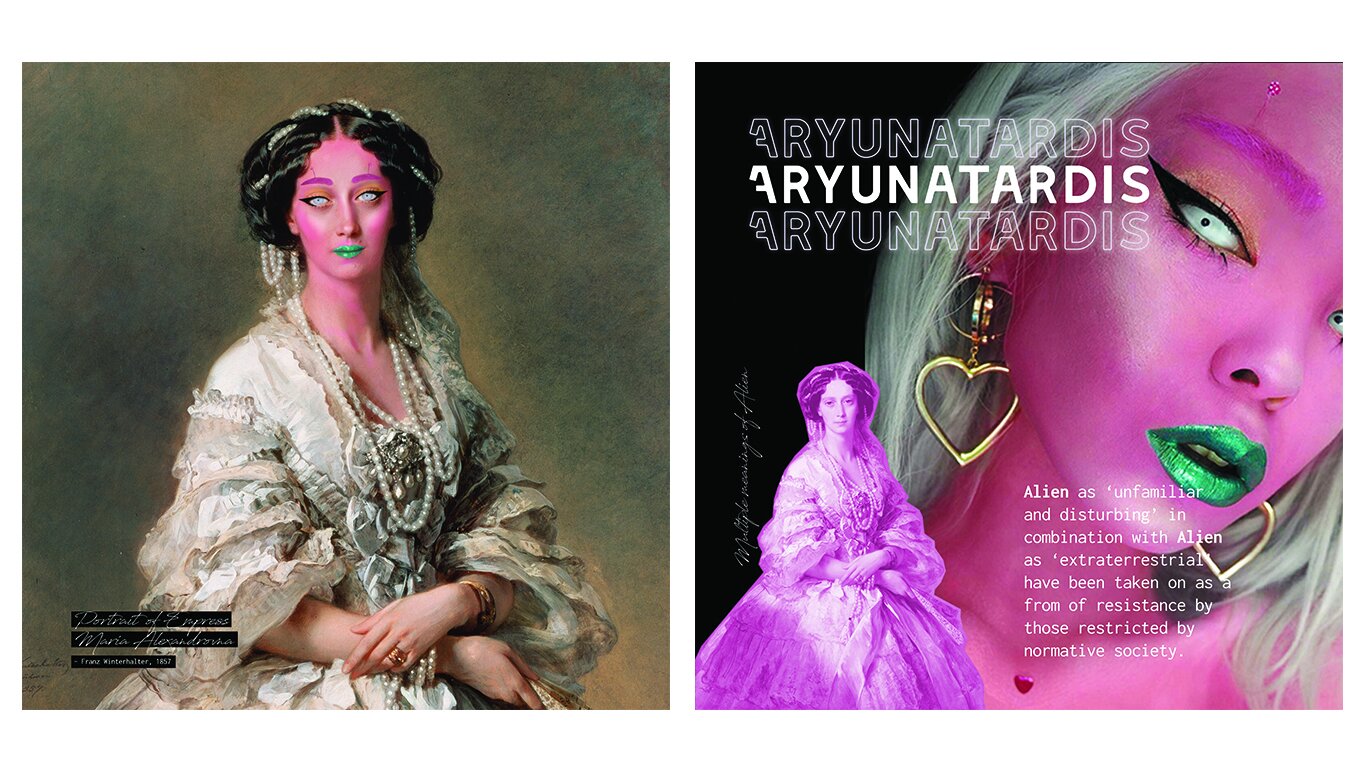
Effigy two
@aryunatardis equally Empress Maria Alexandrovna with zine slide. Presley Mills, @presleymills, 30 December 2018, Instagram, www.instagram.com/p/BsCHfWVB7GK/ .
Defining Beauty
Patzer claims "beauty has a strong, pervasive impact on people'due south lives," impacting their power, social influence, and perceived intelligence. There has been a socially constructed beauty myth that presents itself in the grade of white skin, blue eyes, young, and thin every bit the ideal required to exist beautiful and successful (Mills). This is a colonial and heteronormative beauty construct reflected in the media of Western society and history. Alien dazzler challenges these established constructs besides as the pattern of an ideal human class. To place artists challenging the "human" face and existing dazzler constructs, I outlined the post-obit criteria when selecting artists to reference for the creative component.
Categories:
Skin: "Peel is connected to our bodies withal as well alien, marking the exterior, the end of ourselves" (Lupton 239), meaning pare is the largest organ on the human being body and the protective barrier betwixt the self and the outside world. Skin can denote race and origins and is a universally shared characteristic, yet conflicting beauty often challenges what are conventionally considered natural peel colours (Figure 3). Reminiscent of the grey skin of creatures depicted in flying saucers, cute neon-green cartoons, or the vivid blue scales from superhero films, at that place have been depictions of aliens in media with an endless multifariousness of skin tones and textures. Modifying the pare tone with makeup is i of the easiest means to explore alien beauty and claiming connotations of race.
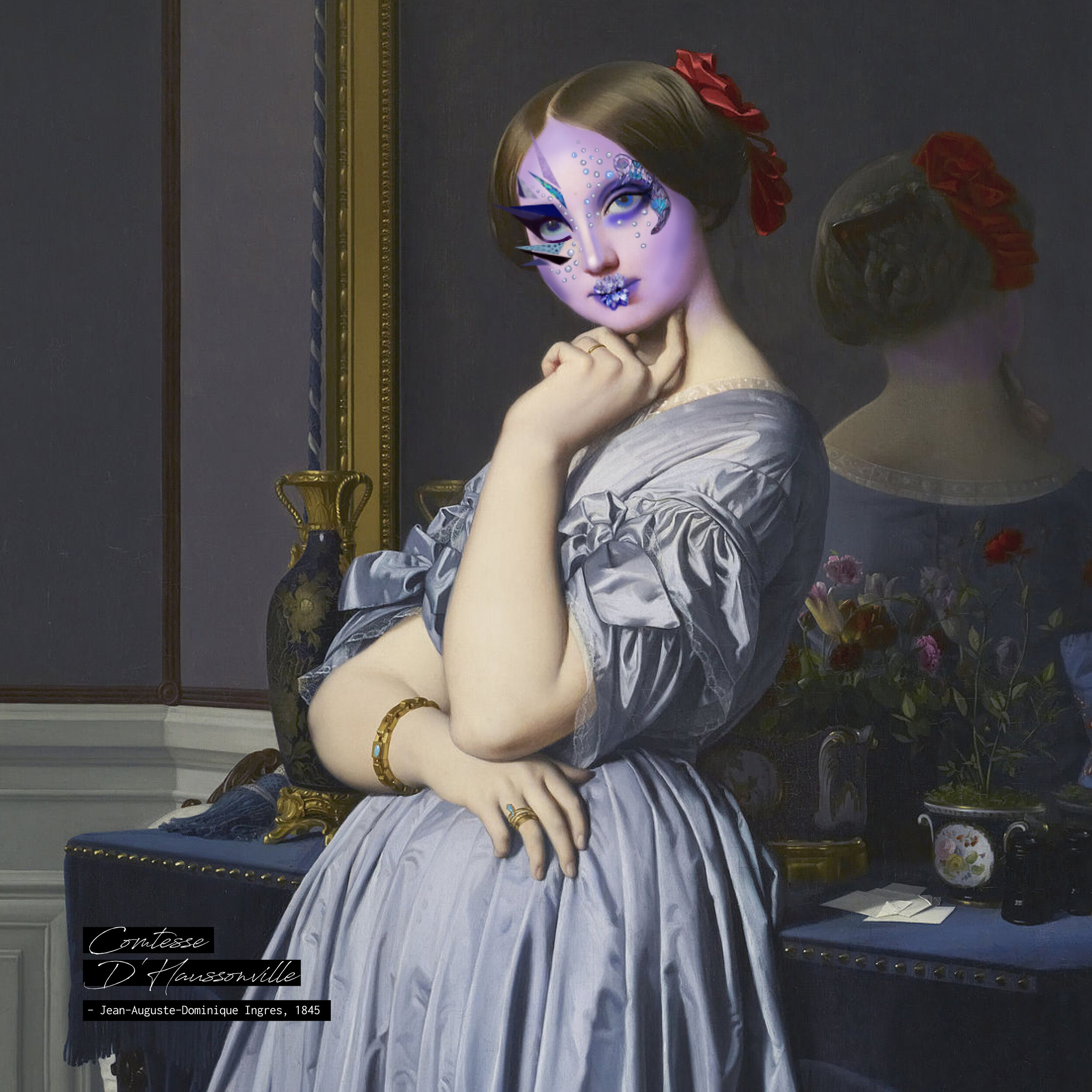
Facial Features: Makeup artists have the skill and power to create dramatic illusions with their makeup. Whether that is through something as mutual equally narrowing the nose or something as dramatic as fully restructuring their face to eliminate unabridged features, the modification of normal homo facial construction can be considered alien beauty. The selected examples misconstrue facial features such as eyes, olfactory organ, mouth, and ears to challenge the notion of what human features are. Looking at optics as an example, artist may multiply the number of eyes beyond two, or they may apply makeup to abstract the conventional shape of the eye beyond recognition (Figure four).

Cyborgs: According to Haraway, any addition to the body can plough the individual into a cyborg. This could theoretically include the makeup used, and the smartphone used to photograph and share the images of the artist. Across makeup and smartphones, cyborg additions tin can exist fabricated up of contact lenses, piercings, wigs, torso modifications, or jewels, crafts, paper, etc. These elements are sometimes decorative, but they may also act every bit extensions to the trunk that modify the normative trunk (Figure 5).

Mail-production: Editing one's selfies has been critiqued because information technology tin can reinforce unrealistic dazzler expectations and contribute torso dissatisfaction (Lonergan et al.), only editing selfies can also be, every bit with makeup, vesture or a haircut, an equivalent tool for self-presentation. This is particularly true when editing is expanded beyond beautification and can become a form of performance art (Kasriel-Alexander). Post-production is flipped when it is applied to alien beauty, equally the await is unrealistic to begin with. Examples of post-production include extending or enlarging body parts, multiplying elements, or smoothing and blending lines and textures (Figure 6). This styling can be viewed as a course of digital 2nd skin as it also provides a boundary between the self and the outside world.

Instagram and the Digital Self
Co-ordinate to MacCallum and Widdows (2018) no paradigm is passive, every bit it is interpreted, critiqued, rejected, and negotiated by individual viewers. Increasingly globalized and homogenized dazzler ideals have emerged in the last few decades, which has correlated with increased rates of both men and adult female feeling unhappy with their appearance (MacCallum and Widdows). Observing media historically, there has been a ascendant beauty trend for women to be thin and white (Mills).
With the growth of social media, Instagram has created space for an online community to share new and diverse images of beauty and makeup.
Instagram is an attainable platform to share creative piece of work equally it does not price money to post and anyone with a smartphone can create an business relationship. Instagram has provided a platform for non-conforming individuals, allowing for self-expression that would otherwise be limited by concrete risk to self (Proulx). According to Proulx:
[T]he Cyberspace was claimed as a space of disembodiment. Theorists of the digital in the 1980s and 1990s projected a networked future not just devoid of the body but besides freed from its corporeal limits. This would be a complimentary space, we were told: free from hateful bigotries and corporeal violence, costless from geographical and political hindrances, free from market place restrictions for professional exchanges, and free from the dangers of "risky" gay sex (Wakeford 1997). (114)
Though this theory has proved to not be entirely accurate, as the digital surround is not costless of bigotry, bigotries, or restrictions, information technology is still a space of disembodiment. This allows for hyper-visibility of gender non-conforming functioning and dramatic reinterpretations of normative notions of beauty without putting individuals at physical run a risk of violence. Individuals sharing images over Instagram can be continued and tin contribute to the media presenting dazzler ideals, increasing the diversity of standards presented.
Selfies are defined as "self-portraits uploaded and shared in social media" (Halpern et al. 99). Maddox explains how selfies accept been critiqued in popular culture equally egotistic and a juvenile "epidemic," but the root of this criticism is centred on individuals who fall outside the dominant heteropatriarchal standard having control of their own cocky-image (26-7, 31). Cocky-portraits shared on Instagram are less likely to be socially policed by normative standards which allows the "Othered" individual (women, racial minorities, queer, transgender, individuals with disabilities, etc.) to turn photography into acknowledgements of their lived experience (Maddox 38-ix). Instagram has allowed makeup artists to create transgressive images to aggrandize the concept of beauty beyond what is normative by creating a digital realm of disembodiment and allowing for hyper-visible forms of functioning (Plewka). The digital self is constructed through the development of a persona, username, and photography. As many of the alien dazzler looks are also complex or not functional for everyday habiliment, their online platform is crucial for their connected existence. Of the artists selected to exist included in this research, many develop a performative version of themselves that can simply exist fully through images. For example, @JunoBirch creates alien dazzler makeup looks on herself, merely this likewise extends to her illustration piece of work and a community of social media followers who recreate her art on their ain body (Figure vii). Her alien persona is extended beyond herself.

The Future of Alien Dazzler
According to WGSN, aspects of the alien fashion may be adopted in pop culture in the class of darker lipsticks and eyeshadows, or in extremely metal or holographic shades, but the true grade of conflicting dazzler currently relies on the human relationship between the homo body and the digital screen (Bailey). These styles will non be possible until further advocacy in engineering exists to farther integrate the physical and the digital realm. The most common representations of alien dazzler will remain fixtures in science fiction films, idiot box, and now the makeup manufacture.
Though alien beauty is farthermost for daily life, selfies are still a common chemical element of social media and alien dazzler can be considered a new course of dandyism for the digital age (Plewka). Similar to Club Kids or Punk of the seventies and eighties, alien beauty possesses the same anti-establishment vigour that pushes the boundaries of beauty (Bailey). As the relationship with social media becomes more and more rooted in daily life, at that place is an opportunity for extreme makeup looks to go a regular part of social performance online.
Works Cited
"Conflicting." Merriam-Webster, 2019, www.merriam-webster.com/lexicon/alien.
Arvin, Mail, et al. "Decolonizing Feminism: Challenging Connections Between Settler Colonialism and Heteropatriarchy." Feminist Formations, vol. 25, no. one, 2013, pp. viii-34.
Bailey, Emily Grace. "Alien Beauty." WGSN, 24 October 2018, https://www-wgsn- com.ezproxy.lib.ryerson.ca/content/board_viewer/#/81404/page/ane.
Boucher, François. Jeanne-Antoinette Poisson, Marquise de Pompadour, c. 1750, Fogg Art Museum, Harvard Academy, Cambridge, Massachusetts. "Jeanne-Antoinette Poisson, Marquise de Pompadour." Wikimedia Commons, 17 November 2012, commons.wikimedia.org/wiki/File:Jeanne-Antoinette_Poisson,_Marquise_de_Pompadour,_by_Francois_Boucher,_1750_with_additions_by_c.1750_and_by_1781_-_Fogg_Art_Museum_-_DSC02299.JPG.
---. Madame Bergeret, c.1766, National Gallery of Art, Washington, DC. "Madame Bergeret." Google Arts & Culture, artsandculture.google.com/nugget/madame-bergeret/TwFs06EqPBEgug.
Botticelli, Sandro. Nascency of Venus, c. 1482, Uffizi Gallery, Florence, Italy. "Nativity of Venus," Artstor, artstor.wordpress.com/2016/12/xv/artstor-searches-highlight-women/scala_archives_1031314669/.
David, Jacques-Louis. Portrait of Madame de Verninac, c. 1799, Louvre Museum, Paris, French republic. "Portrait of Madame de Verninac." Wikimedia Commons, commons.wikimedia.org/wiki/File:Portrait_de_madame_de_Verninac_by_David_Louvre_RF1942-16_n2.jpg.
Gainsborough, Thomas. Mary Heberden, c. 1777, Yale Center for British Art, New Haven, Connecticut. "Mary Heberden." Google Arts & Culture, artsandculture.google.com/nugget/mary-heberden/LQGnIwkNP3dJBA.
Gomel, Elena. Science Fiction, Conflicting Encounters, and the Ideals of Posthumanism: Beyond the Golden Rule. Palgrave Macmillan, 2014.
Halpern, Daniel, et al. "'Selfie-ists' or 'narci-selfiers'?: A cross- lagged panel assay of selfie taking and narcissism." Personality and Individual Differences, vol. 97, 2016, pp. 98-101.
Haraway, Donna. A Cyborg Manifesto: Scientific discipline, Engineering, and Socialist-Feminism in the Late Twentieth Century. Routledge, 1991.
Hernandez, Gabriela. Classic Beauty: The History of Makeup. Schiffer Publishing, 2017.
Hungry. "The Official Website of Hungry (@isshehungry)." Hungry, https://www.isshehungry.com/bio/.
Ingres, Jean-Auguste-Dominique. Comtesse D'Haussonville, 1845, the Frick Drove, New York, New York. "Comtesse D'Haussonville." Wikimedia Eatables, eatables.m.wikimedia.org/wiki/File:Jean-Auguste-Dominique_Ingres_-_Comtesse_d%27Haussonville_-_Google_Art_Project.jpg#mw-bound-to-license.
Jowett, Victoria. "There's a new Jeffree Star eyeshadow palette coming, and the internet can't cope." Cosmopolitan, 1 November 2018, www.cosmopolitan.com/u.k./beauty-hair/makeup/a24506408/jeffree-star-conflicting-eyeshadow-palette/.
Justice, Christopher. "Sidney I. Dobrin, ed.Writing Posthumanism, Posthuman Writing."Rhizomes: Cultural Studies in Emerging Knowledge, vol. 32, 2017, pp. one-4.
Kasriel-Alexander, Daphne. "Get Over It! #NoFilter Is Dead and Selfie Editing Empowers You." Creative Contagious, 1 February 2018, medium.com/creative-contagious/let-selfie-editing-out-of-the-doghouse-whats-wrong-with-an-app-form-628a5ea369dc.
Lonergan, Alexandra Rhodes, et al. "Me, my selfie, and I: The human relationship between editing and posting selfies and body dissatisfaction in men and women." Body Epitome, vol. 28, 2019, pp. 39-43.
Lupton, Ellen. Pare: Surface, Substance, and Design. Princeton Architectural Press, 2002.
MacCallum, Fiona, and Heather Widdows. "Altered Images: Agreement the Influence of Unrealistic Images and Beauty Aspirations." Wellness Care Assay, vol. 26, no. iii, 2018, pp. 235-45.
Maddox, Jessica Leigh. "Fear and Selfie-Loathing in America: Identifying the Interstices of Othering, Iconoclasm, and the Selfie." Journal of Popular Civilisation, vol. 51, no. 1, 2018, pp. 26-49.
Manet, Edouard. Olympia, c. 1863–1865, Musée D'Orsay, Paris, French republic. "Olympia." Artstor, artstor.wordpress.com/2016/12/15/artstor-searches-highlight-women/lessing_art_1039490311/.
Mills, Hailey Fifty. "Avatar Creation: The Social Construction of 'Dazzler' in Second Life." Journalism and Mass Communication Quarterly, vol. 95, no. 3, 2017, pp. 607-24.
Patzer, Gordon 50. The Physical Bewitchery Phenomena. Plenum Press, 1985.
Plewka, Karl. "Subverting Selfie Culture." Concern of Manner, 28 May 2018, www.businessoffashion.com/articles/beauty/pushing-boundaries-in-the-historic period-of-virtual-vanity.
Proulx, Mikhel. "Protocol and Performativity: Queer selfies and the coding of online identity." Performance Research: A Journal of Performing Arts, vol. 21, no. five, 2016, pp. 114-18.
Solarin, Ayoola. "Juno Birch makes an fine art out of taking the piss." Dazed Mag, 29 June 2018, www.dazeddigital.com/art-photography/article/40526/1/juno-birch-makes-an-art-out-of-taking-the-piss.
Thompson, Gregory. "xv Most Stunning Aliens in Star Trek." Screen Bluster, 20 October 2017, screenrant.com/star-trek-steamiest-aliens/
Tirosh-Samuelson, Hava. "Transhumanism As A Secularist Faith." Zygon: Journal of Religion and Science, vol. 47, no. iv, 2012, pp. 710-34.
Weinstock, Tish. "This make-up artist is redefining dazzler with her extreme looks." i-D, 3 May 2018, i-d.vice.com/en_uk/article/a3yxdb/this-make-up-artist-is-redefining-beauty-with-her-extreme-looks.
Whitelocks, Sadie. "Eight hours getting set for a night out? Powerful self-portrait series reveals male photographer'south elaborate political party looks." DailyMail, 25 November 2013, www.dailymail.co.united kingdom of great britain and northern ireland/femail/article-2513315/Ryan-Burkes-cocky-portrait-series-reveals-photographers-elaborate-party-looks.html.
Winterhalter, Franz Xaver. Portrait of Empress Maria Alexandrovna, c. 1857, Land Hermitage Museum, St. petersburg, Russia. "Maria Alexandrovna."Wikimedia Commons, https://commons.wikimedia.org/wiki/File:Maria_Alexandrovna_by_Winterhalter_(1857,_Hermitage).jpg.
Author Biography

Presley Mills
RYERSON UNIVERSITY
Presley is a Métis designer, illustrator, and researcher based in Canada.
She is a graduate of the Alberta College of Art & Design, focused on ad, graphic blueprint, and illustration and is currently her receiving her Master of Arts in Fashion from Ryerson University. Her research is primarily focused on how style and futurism tin be used to foster inclusion, community, and reconciliation.
Commodity Citation
Mills, Presley. "Alien Beauty: Posthuman Re-Imaginings" Manner Studies, vol. 2, no. one, 2019, pp. 1-23, www.fashionstudies.ca/alien-beauty/, https://doi.org/10.38055/FS020105.
Copyright © 2019 Style Studies - All Rights Reserved
Artistic Eatables Attribution-NonCommercial-NoDerivatives 4.0 International (CC BY-NC-ND 4.0) license

Custom Clothing Technology: Diffusion of Luxury Practices in Style by Nicholas Paganelli
Hyper-Consumerism and Abstract Mural in Asia by Marie Genevieve Cyr and Joseph Jagos

Source: https://www.fashionstudies.ca/alien-beauty
Posted by: lupientorty1994.blogspot.com
0 Response to "Where To Find Alien Rave Makeup"
Post a Comment