

What Are The Two Parts Of Whole Blood And What Percentages Does Each Makeup
Unremarkably, seven-8% of human being torso weight is from blood. In adults, this amounts to 4.5-6 quarts of blood. This essential fluid carries out the disquisitional functions of transporting oxygen and nutrients to our cells and getting rid of carbon dioxide, ammonia, and other waste product products. In addition, it plays a vital role in our immune system and in maintaining a relatively constant torso temperature. Blood is a highly specialized tissue composed of more than than four,000 different kinds of components. Iv of the most important ones are ruddy cells, white cells, platelets, and plasma. All humans produce these blood components--there are no populational or regional differences.
Ruby-red Cells
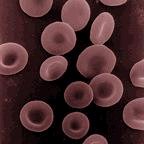 | |
| Human erythrocytes or "red cells" (jail cell diameter well-nigh .0003 inches) |
Cerise cells, or erythrocytes  , are relatively large microscopic cells without nuclei. In this latter trait, they are like to the primitive prokaryotic cells of bacteria. Red cells usually make up forty-fifty% of the full blood volume. They transport oxygen from the lungs to all of the living tissues of the body and behave away carbon dioxide. The red cells are produced continuously in our os marrow from stem cells at a rate of nigh 2-three million cells per 2d. Hemoglobin is the gas transporting protein molecule that makes up 95% of a red cell. Each red prison cell has about 270,000,000 atomic number 26-rich hemoglobin molecules. People who are anemic generally take a deficiency in blood-red cells, and afterward experience drawn due to a shortage of oxygen. The ruby-red colour of blood is primarily due to oxygenated red cells. Human fetal hemoglobin molecules differ from those produced by adults in the number of amino acid bondage. Fetal hemoglobin has three chains, while adults produce merely two. Equally a consequence, fetal hemoglobin molecules attract and transport relatively more oxygen to the cells of the body.
White Cells
White cells, or leukocytes , exist in variable numbers and types but brand up a very small part of claret'southward volume--normally only virtually 1% in healthy people. Leukocytes are not limited to blood. They occur elsewhere in the body also, most notably in the spleen, liver, and lymph glands. Most are produced in our bone marrow from the same kind of stem cells that produce red claret cells. Others are produced in the thymus gland, which is at the base of the cervix. Some white cells (called lymphocytes ) are the get-go responders for our immune organization. They seek out, identify, and bind to conflicting poly peptide on bacteria, viruses, and fungi so that they can be removed. Other white cells (called granulocytes and macrophages ) so arrive to surround and destroy the alien cells. They besides have the function of getting rid of dead or dying blood cells as well every bit foreign affair such as dust and asbestos. Ruby cells remain viable for only most 4 months before they are removed from the claret and their components recycled in the spleen. Individual white cells normally but last 18-36 hours earlier they also are removed, though some types live every bit much equally a year. The description of white cells presented hither is a simplification. At that place are actually many specialized sub-types of them that participate in different ways in our immune responses.
Platelets
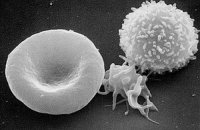 | |
| erythrocyte (left), thrombocyte (center), and leukocyte (right) |
Platelets , or thrombocytes , are prison cell fragments without nuclei that work with blood clotting chemicals at the site of wounds. They do this by adhering to the walls of blood vessels, thereby plugging the rupture in the vascular wall. They also can release coagulating chemicals which cause clots to form in the claret that tin plug upwardly narrowed blood vessels. 13 different blood clotting factors, in addition to platelets, need to interact for clotting to occur. They do so in a cascading manner, one factor triggering another. Hemophiliacs lack the ability to produce either blood factor eight or 9.
Platelets are not equally effective in clotting blood throughout the entire day. The torso's circadian rhythm system (its internal biological clock) causes the peak of platelet activation in the morn. This is one of the main reasons that strokes and heart attacks are more than common in the forenoon.
Contempo enquiry has shown that platelets as well help fight infections by releasing proteins that impale invading bacteria and some other microorganisms. In improver, platelets stimulate the immune system. Individual platelets are about i/three the size of cherry cells. They accept a lifespan of nine-10 days. Like the cherry and white blood cells, platelets are produced in bone marrow from stem cells.
Plasma
Plasma is the relatively clear, yellow tinted water (92+%), sugar, fat, poly peptide and salt solution which carries the red cells, white cells, and platelets. Ordinarily, 55% of our blood'south volume is fabricated up of plasma. As the heart pumps blood to cells throughout the body, plasma brings nourishment to them and removes the waste matter products of metabolism. Plasma as well contains blood clotting factors, sugars, lipids, vitamins, minerals, hormones, enzymes, antibodies, and other proteins. It is likely that plasma contains some of every protein produced by the body--approximately 500 have been identified in human plasma then far.
 Blood Components--animated view of the major blood components.
This link takes you to an external website. To render here, yous must
click the "back" button on your browser program. (length = 53 secs)
Agglutination
Sometimes when the blood of ii people is mixed together, it clumps or forms visible islands in the liquid plasma--the scarlet cells become fastened to i another. This is agglutination .
When different types of blood are mixed within the torso, the reaction can exist a bursting of the red cells as well equally agglutination. Dissimilar types of blood are recognized on the molecular level and sometimes rejected by existence destroyed and ultimately filtered out by the kidneys in gild to expel them from the body along with urine. In the case of a transfusion mistake, at that place can be so much of the wrong type of claret in the system that it can result in kidney failure and death. This is due to the fact that when the kidneys try to filter the claret, they essentially become clogged as they are overwhelmed and stop being constructive filters. Additionally, at that place is a rapid depletion of claret clotting factors which causes bleeding from every body orifice. In the United States, about ane in 12,000 units of whole blood transfused is given to the wrong person. Depending on the blood types of the donor and the recipient, this tin can result in decease or no problems at all.
The compositional divergence betwixt blood types is in the specific kinds of antigens institute on the surface of the ruddy cells. Antigens are relatively big protein molecules that provide the biological signature of an individual'due south blood type.
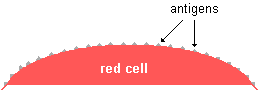 |
| (non actual shape or size of antigens) |
Within blood, at that place are substances called antibodies which distinguish particular antigens from others, causing bursting or agglutination of the red cells when alien antigens are found. The antibodies bind to the antigens. In the case of agglutination, the antibodies "glue" together the antigens from different red cells thereby sticking the ruddy cells together (as shown below on the right).
| Antibodies seeking specific antigens | Antibodies agglutinating reddish cells | |
| | 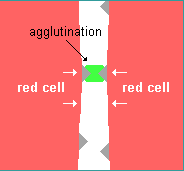 | |
| (not actual shape or size of antigens and antibodies) | ||
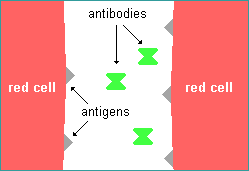
Every bit agglutination proceeds, millions of reddish cells are glued together into clumps. This is not the same matter as clotting. When agglutination occurs, the blood by and large remains liquid. With clotting, however, it does not.
The specific types of antigens on our cherry-red claret cells decide our blood types. There are 29 known human blood systems, or groups, for which each of us tin be typed. As a issue, there are one or more than antigens for each of these claret groups. Since many of these claret systems also are institute in apes and monkeys, information technology is likely that they evolved prior to the fourth dimension that nosotros became a separate species.
History of Blood Transfusions
Long before the phenomenon of blood antigen-antibody interaction was discovered, surgeons experimented with human transfusions in an attempt to save the lives of patients who were dying from severe claret loss and the resulting shock. The kickoff attempt may have been an English doc during the mid-17th century who infused a wounded soldier with sheep blood. Non surprisingly, the soldier suffered a painful death. The first successful transfusion of human blood to some other human was done by a British doctor in 1818 in society to salvage the life of a woman who was hemorrhaging following childbirth. By the mid 19th century, European and American doctors used transfusions in a concluding ditch attempt to save soldiers and other patients with horrendous wounds. They usually transferred blood directly from a healthy individual to their patient via a rubber tube with hypodermic needles at each end. This occasionally resulted in success but generally killed the recipient. The results seemed to be random. Doctors in the 19th century also experimented with a variety of claret substitutes, including milk, water, and even oils.
It was the discovery of the ABO blood types in 1900 that finally led usa to understand how to consistently employ transfusions to save lives. Even with this knowledge, even so, life threatening reactions still occur in near one out of 80,000 transfusions in developed nations. The ABO claret grouping and its central role in transfusion failures are described in the side by side section of this tutorial.
White Cell Antibodies
The claret type antigen-antibody interaction is one of many similar recognition-rejection phenomena in our bodies. Infectious microorganisms, such as viruses, also carry strange antigens which stimulate the production of white prison cell antibodies (lymphocytes) that attack the antigens by bounden to them every bit a way of getting rid of the invading parasites. Once stalk cells in our bone marrow produce antibodies to identify a specific alien antigen, we accept the ability to produce them more chop-chop and in larger numbers. This results in the evolution of a long-term active amnesty to hereafter invasions of the same kind of alien antigen. This is the key to successful vaccination for viruses and some other microorganisms that invade our bodies.
Allowed Cells in Action--developing amnesty to a virus via the antigen-antibody interaction.
This link takes you to a QuickTime video. To return here, y'all must click the "back" button
on your browser plan. (length = 1 min, 40 secs)
White cell antibodies are too responsible for recognizing and rejecting conflicting body tissues, or, more accurately, the antigens on their cells. This is the main reason that organ transplants were nigh ofttimes unsuccessful in the past until the creation of drugs that can suppress the immune organisation and thereby forestall organ rejection. The immune organisation that is responsible is called the human leukocyte antigen (HLA) system. This is by far the almost polymorphic of all known human genetic systems--in that location are more than than 100 antigens on tissue cells in humans resulting in approximately 30,000,000 possible HLA genotypes. The chance of two unrelated people having the same HLA genotypes is very slim. Subsequently, HLA incompatibility between organ donors and recipients are common.
Note: Antibodies are also known as "agglutinins" and antigens every bit "agglutinogens". This culling terminology is non used hither considering of the potential confusion of similar words.
NOTE: Information technology is now known that the blood of some women who accept been pregnant tin can cause a life-threatening reaction in people who receive transfusions from them. This reaction is known as "transfusion-related acute lung injury" (TRALI). This can occur if the donor's claret contains antibodies produced past her body during a pregnancy in order to forbid rejection of claret jail cell antigens in male fetuses. The likelihood of this occurring apparently is higher for women who have given birth more than once. TRALI patently is mainly a problem if the blood recipient receives plasma rather than whole blood. Because of the chance, the American Red Cross is shifting to using 95% male plasma donors. In the recent past, information technology has been 50% male.
Copyright � 1999-2013 by Dennis O'Neil. All rights reserved.
illustration credits
Source: https://www2.palomar.edu/anthro/blood/blood_components.htm
Posted by: lupientorty1994.blogspot.com
0 Response to "What Are The Two Parts Of Whole Blood And What Percentages Does Each Makeup"
Post a Comment