

How To Draw Susan From The Lion The Witch And The Wardrobe Drawing
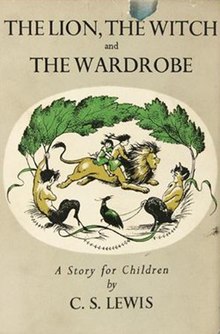 First edition dustjacket | |
| Author | C. Due south. Lewis |
|---|---|
| Illustrator | Pauline Baynes |
| Cover artist | Pauline Baynes |
| Country | United Kingdom |
| Language | English |
| Series | The Chronicles of Narnia |
| Genre | Children's fantasy, Christian literature |
| Publisher | Geoffrey Bles |
| Publication date | xvi October 1950 |
| Media type | Print (hardcover and paperback), e-book |
| OCLC | 7207376 |
| LC Grade | PZ8.L48 Li[ane] |
| Followed past | Prince Caspian |
The Lion, the Witch and the Wardrobe is a fantasy novel for children by C. Due south. Lewis, published by Geoffrey Bles in 1950. Information technology is the first published and best known of 7 novels in The Chronicles of Narnia (1950–1956). Amid all the author'due south books, it is also the most widely held in libraries.[2] Although it was originally the first of The Chronicles of Narnia, it is volume two in recent editions that are sequenced past the stories' chronology. Similar the other Chronicles, it was illustrated past Pauline Baynes, and her work has been retained in many after editions.[1] [3]
Most of the novel is fix in Narnia, a land of talking animals and mythical creatures that is ruled past the evil White Witch. In the frame story, four English children are relocated to a large, old country house following a wartime evacuation. The youngest, Lucy, visits Narnia three times via the magic of a wardrobe in a spare room. Lucy's three siblings are with her on her 3rd visit to Narnia. In Narnia, the siblings seem fit to fulfill an old prophecy and find themselves adventuring to save Narnia and their ain lives. The lion Aslan gives his life to relieve one of the children; he later on rises from the dead, vanquishes the White Witch, and crowns the children Kings and Queens of Narnia.
Lewis wrote the book for (and dedicated it to) his goddaughter, Lucy Barfield. She was the daughter of Owen Barfield, Lewis's friend, instructor, adviser and trustee.[4] In 2003, The Lion, the Witch and the Wardrobe was ranked ninth on the BBC'southward The Large Read poll.[5] Time mag included the novel in its list of the 100 All-time Immature-Adult Books of All Time,[6] equally well as its listing of the 100 best English language-language novels published since 1923.[7]
Plot [edit]
Peter, Susan, Edmund and Lucy Pevensie are evacuated from London in 1940, to escape the Rush, and sent to live with Professor Digory Kirke at a large house in the English countryside. While exploring the firm, Lucy enters a wardrobe and discovers the magical world of Narnia. Here, she meets the faun named Tumnus, whom she addresses equally "Mr. Tumnus". Tumnus invites her to his cave for tea and admits that he intended to report Lucy to the White Witch, the false ruler of Narnia who has kept the country in perpetual winter, but he repents and guides her dorsum home. Although Lucy'southward siblings initially disbelieve her story of Narnia, Edmund follows her into the wardrobe and winds upwards in a separate area of Narnia and meets the White Witch, who calls herself the Queen of Narnia. The Witch plies Edmund with Turkish please and persuades him to bring his siblings to her with the promise of being made a prince. Edmund reunites with Lucy and they both return domicile. However, Edmund denies Narnia's existence to Peter and Susan after learning of the White Witch's identity from Lucy.
Soon subsequently, all iv children enter Narnia together, but find that Tumnus has been arrested for treason. The children are befriended by Mr. and Mrs. Beaver, who tell them of a prophecy that claims the White Witch'due south rule will stop when "two Sons of Adam and two Daughters of Eve" sit on the four thrones of Cair Paravel, and that Narnia's true ruler – a great king of beasts named Aslan – is returning at the Rock Table later on several years of absenteeism. Edmund slips abroad to the White Witch's castle, where he finds a courtyard filled with the Witch's enemies turned into stone statues. Edmund reports Aslan's render to the White Witch, who begins her movement toward the Rock Table with Edmund in tow, and orders the execution of Edmund's siblings and the Beavers. Meanwhile, the Beavers realise where Edmund has gone, and lead the children to encounter Aslan at the Stone Tabular array. During the trek, the group notices that the snow is melting, and take it as a sign that the White Witch'due south magic is fading. This is confirmed by a visit from Father Christmas, who had been kept out of Narnia by the Witch'due south magic, and he leaves the group with gifts and weapons.
The children and the Beavers reach the Stone Tabular array and run into Aslan and his regular army. The White Witch's wolf captain Maugrim approaches the army camp and attacks Susan, but is killed by Peter. The White Witch arrives and parleys with Aslan, invoking the "Deep Magic from the Dawn of Fourth dimension" which gives her the right to kill Edmund for his treason. Aslan and then speaks to the Witch solitary, and on his return he announces that the Witch has renounced her claim on Edmund'due south life. Aslan and his followers so motion the encampment on into the nearby forest. That evening, Susan and Lucy secretly follow Aslan to the Rock Tabular array. They watch from a distance every bit the Witch puts Aslan to expiry – as they had agreed in their pact to spare Edmund. The next morning, Aslan is resurrected by the "Deeper Magic from before the Dawn of Time", which has the power to contrary death if a willing victim takes the place of a traitor. Aslan takes the girls to the Witch'south castle and revives the Narnians that the Witch had turned to stone. They join the Narnian forces battling the Witch's army. The Narnian army prevails, and Aslan kills the Witch. The Pevensie children are then crowned kings and queens of Narnia at Cair Paravel.
After a long and happy reign, the Pevensies, now adults, keep a hunt for the White Stag who is said to grant the wishes of those who catch it. The four arrive at the lamp-post marker Narnia's archway and, having forgotten well-nigh it, unintentionally laissez passer through the wardrobe and return to England; they are children again, with no fourth dimension having passed since their departure. They tell the story to Kirke, who believes them and reassures the children that they will return to Narnia one day when they least expect information technology.
Main characters [edit]
- Lucy is the youngest of four siblings. In some respects, she is the chief character of the story. She is the showtime to discover the state of Narnia, which she enters inadvertently when she steps into a wardrobe while exploring the Professor's house. When Lucy tells her iii siblings about Narnia, they do not believe her: Peter and Susan think she is just playing a game, while Edmund persistently ridicules her. In Narnia, she is crowned Queen Lucy the Valiant.
- Edmund is the 2nd-youngest of iv siblings. He has a bad relationship with his brother and sisters. Edmund is known to be a liar, and often harasses Lucy. Lured by the White Witch's hope of power and an unlimited supply of magical treats, Edmund betrays his siblings. He later repents and helps defeat the White Witch. He is eventually crowned Male monarch Edmund the Just.
- Susan is the second-oldest sibling. She does not believe in Narnia until she actually goes in that location. She and Lucy accompany Aslan on the journey to the Rock Tabular array, where he allows the Witch to accept his life in place of Edmund's. Tending to Aslan'southward carcass, she removes a muzzle from him to restore his dignity and oversees a horde of mice who gnaw away his bonds. She then shares the joy of his resurrection and the try to bring reinforcements to a critical boxing. Susan is crowned Queen Susan the Gentle.
- Peter is the eldest sibling. He judiciously settles disputes between his younger brother and sisters, often rebuking Edmund for his attitude. Peter also disbelieves Lucy's stories about Narnia until he sees it for himself. He is hailed equally a hero for the slaying of Maugrim and for his command in the battle to overthrow the White Witch. He is crowned High King of Narnia and dubbed Male monarch Peter the Magnificent.
- Aslan, a lion, is the rightful King of Narnia and other magic countries. He sacrifices himself to salve Edmund, but is resurrected in fourth dimension to aid the denizens of Narnia and the Pevensie children confronting the White Witch and her minions. As the "son of the Emperor beyond the ocean" (an innuendo to God the Father), Aslan is the all-powerful creator of Narnia. Lewis revealed that he wrote Aslan as a portrait, although non an allegorical portrait, of Christ.[8]
- The White Witch is the land'due south self-proclaimed queen and the primary antagonist of the story. Her reign in Narnia has fabricated winter persist for a hundred years with no end in sight. When provoked, she turns creatures to rock with her wand. She fears the fulfillment of a prophecy that "2 sons of Adam and two daughters of Eve" (pregnant two male humans and 2 female person humans) will supersede her. She is normally referred to every bit "the White Witch", or just "the Witch". Her actual name, Jadis, appears once in the notice left on Tumnus's door after his arrest. Lewis later wrote a prequel to include her back story and account for her presence in the Narnian earth.
- The Professor is a kindly old admirer who takes the children in when they are evacuated from London. He is the offset to believe that Lucy did indeed visit a country called Narnia. He tries to convince the others logically that she did not make information technology up. After the children render from Narnia, he assures them that they volition return i solar day. The book hints that he knows more of Narnia than he lets on (hints expanded upon in later books of the serial).
- Tumnus, a faun, is the first individual Lucy (who calls him "Mr. Tumnus") meets in Narnia. Tumnus befriends Lucy, despite the White Witch's standing order to turn in whatever human he finds. He initially plans to obey the gild but, later on getting to like Lucy, he cannot bear to warning the Witch'southward forces. He instead escorts her back towards the safety of her own country. His good human action is later given away to the Witch by Edmund. The witch orders Tumnus arrested and turns him to rock, merely he is afterwards restored to life past Aslan.
- Mr. and Mrs. Beaver, ii beavers, are friends of Tumnus. They play host to Peter, Susan and Lucy and lead them to Aslan.
Writing [edit]
Lewis described the origin of The Lion, the Witch and the Wardrobe in an essay titled "It All Began with a Picture":[9]
- The Lion all began with a motion picture of a Faun carrying an umbrella and parcels in a snowy wood. This picture had been in my mind since I was about xvi. Then 1 twenty-four hour period, when I was well-nigh xl, I said to myself: 'Permit'due south attempt to make a story nigh information technology.'
Soon before the Second World War, many children were evacuated from London to the English language countryside to escape bombing attacks on London by Nazi Germany. On 2 September 1939, 3 school girls, Margaret, Mary, and Katherine,[10] [11] came to live at The Kilns in Risinghurst, Lewis'southward dwelling house iii mi (4.8 km) east of Oxford city heart. Lewis afterwards suggested that the experience gave him a new appreciation of children, and in late September,[12] he began a children'south story on an odd sheet that has survived as part of some other manuscript:
- This book is about four children whose names were Ann, Martin, Rose and Peter. But it is about about Peter, who was the youngest. They all had to become away from London of a sudden because of Air Raids, and because Father, who was in the Ground forces, had gone off to the War and Mother was doing some kind of war piece of work. They were sent to stay with a kind of relation of Mother's who was a very former professor who lived all by himself in the country.[13]
How much more of the story Lewis then wrote is uncertain. Roger Lancelyn Greenish thinks that he might fifty-fifty take completed it. In September 1947, Lewis wrote in a letter about stories for children: "I take tried one myself, merely it was, by the unanimous verdict of my friends, then bad that I destroyed it."[14]
The plot chemical element of entering a new world through the back of a wardrobe had certainly entered Lewis's mind past 1946, when he used information technology to depict his first run into with really good poesy:
- I did not in the least feel that I was getting in more quantity or better quality a pleasure I had already known. It was more as if a cupboard which one had hitherto valued as a place for hanging coats proved one day, when you opened the door, to lead to the garden of the Hesperides ...[15]
In August 1948, during a visit by an American writer, Chad Walsh, Lewis talked vaguely most completing a children's volume he had begun "in the tradition of Eastward. Nesbit".[16] After this conversation, not much happened until the offset of the next twelvemonth. Then everything changed. In his essay "It All Began With a Film", Lewis continues: "At first I had very little idea how the story would go. But and so suddenly Aslan came bounding into it. I think I had been having a good many dreams of lions about that time. Autonomously from that, I don't know where the Lion came from or why he came. Merely one time he was there, he pulled the whole story together, and soon he pulled the six other Narnian stories in afterwards him."[17]
The major ideas of the book echo lines Lewis had written xiv years earlier in his alliterative poem "The Planets":
- ... Of wrath ended
- And woes mended, of wintertime passed
- And guilt forgiven, and good fortune
- JOVE is principal; and of jocund revel,
- Laughter of ladies. The lion-hearted
- ... are Jove'south children.[18]
This resonance is a central component of the instance, promoted chiefly by Oxford University scholar Michael Ward, for the seven Chronicles having been modelled upon the seven classical astrological planets, The Panthera leo, the Witch and the Wardrobe upon Jupiter.[19]
On ten March 1949, Roger Lancelyn Green dined with Lewis at Magdalen Higher. After the repast, Lewis read two chapters from his new children's story to Green. Lewis asked Green's opinion of the tale, and Light-green said that he thought it was expert. The manuscript of The Lion, the Witch and the Wardrobe was complete past the finish of March 1949. Lucy Barfield received it by the end of May.[xx] When on sixteen October 1950 Geoffrey Bles in London published the first edition, three new "chronicles", Prince Caspian, The Voyage of the Dawn Treader, and The Horse and His Male child, had also been completed.
Illustrations [edit]
Lewis's publisher, Geoffrey Bles, allowed him to choose the illustrator for the novel and the Narnia series. Lewis chose Pauline Baynes, perhaps based on J. R. R. Tolkien'south recommendation. In December 1949, Bles showed Lewis the first drawings for the novel, and Lewis sent Baynes a note congratulating her, particularly on the level of particular. Lewis's appreciation of the illustrations is axiomatic in a letter he wrote to Baynes after The Last Boxing won the Carnegie Medal for best children'due south volume of 1956: "is information technology not rather 'our' medal? I'm sure the illustrations were taken into account, as well as the text".[21]
The British edition of the novel had 43 illustrations; American editions generally had fewer. The pop U.Due south. paperback edition published by Collier between 1970 and 1994, which sold many millions, had simply 17 illustrations, many of them severely cropped from the originals, giving many readers in that country a very dissimilar experience when reading the novel. All the illustrations were restored for the 1994 worldwide HarperCollins edition, although these illustrations lacked the clarity of early printings.[22]
Reception [edit]
Lewis very much enjoyed writing The Lion, the Witch and the Wardrobe and embarked on the sequel Prince Caspian soon afterwards finishing the outset novel. He completed the sequel by end of 1949, less than a year later finishing the initial book. The Lion, the Witch and the Wardrobe had few readers during 1949 and was not published until late in 1950, so his initial enthusiasm did not stalk from favourable reception past the public.[23]
While Lewis is known today on the force of the Narnia stories as a highly successful children's writer, the initial critical response was muted. At the time, children's stories existence realistic was fashionable; fantasy and fairy tales were seen every bit indulgent, appropriate simply for very young readers and potentially harmful to older children, even hindering their ability to relate to everyday life. Some reviewers considered the tale overtly moralistic or the Christian elements overstated attempts to indoctrinate children. Others were concerned that the many trigger-happy incidents might frighten children.[24]
Lewis'southward publisher, Geoffrey Bles, feared that the Narnia tales would not sell, and might damage Lewis's reputation and impact sales of his other books. Nevertheless, the novel and its successors were highly popular with immature readers, and Lewis's publisher was soon eager to release further Narnia stories.[25]
A 2004 U.S. report plant that The King of beasts was a mutual read-aloud book for seventh graders in schools in San Diego County, California.[26] In 2005, it was included on Time 's unranked list of the 100 best English-linguistic communication novels published since 1923.[27] Based on a 2007 online poll, the U.S. National Pedagogy Association listed it every bit one of its "Teachers' Pinnacle 100 Books for Children".[28] In 2012, information technology was ranked number five among all-time children'southward novels in a survey published by School Library Journal, a monthly with primarily U.South. audience.[29]
A 2012 survey past the University of Worcester determined that it was the second-most common book that Great britain adults had read as children, subsequently Alice's Adventures in Wonderland. (Adults, perhaps limited to parents, ranked Alice and The Lion 5th and 6th as books the side by side generation should read, or their children should read during their lifetimes.)[thirty]
TIME included the novel in its "All-time 100 Novels" (all-time English-linguistic communication novels from 1923 to 2005).[27] In 2003, the novel was listed at number 9 on the BBC'due south survey The Big Read.[31] It has as well been published in 47 foreign languages.[32]
Reading lodge [edit]
The matter of the reading social club of the Narnia serial, in the context of the alter in their publication order—from its original (beginning with The Lion, the Witch and the Wardrobe) to the later adopted, now pervasive chronology-of-events order (beginning with The Sorcerer's Nephew)—has been a matter of extensive word for many years.[33] The Lion... was originally published as the outset book in the Chronicles, and about reprintings of the novels reflected that order, until difference with the Collins' "Fontana Lions" edition in 1980.[33] : 42 Change, however, had begun before—the listing of the books in the English Puffins editions as early on every bit 1974 presented a list as a suggested reading order that placed Magician's first—and with the Collins' edition, the move to the chronological gild, and the series opening with Magician's was formalised.[33] : 42 Walter Hooper, for one, was pleased with this, stating that the books could now exist read in the social club that Lewis' himself "said they should".[34] When HarperCollins presented its uniform, worldwide edition of the series in 1994, it also used this sequence, going so far as to state that its "editions of the Chronicles... take been numbered in compliance with the original wishes of the author, C.S. Lewis."[33] : 42–43
In a piece of work of literary criticism, Imagination and the Arts in C. S. Lewis, scholar Peter J. Schakel calls into question the clarity and simplicity of these conclusions, citing a multifariousness of evidences that oppose a singular view of a correct viewing order, evidences that include Lewis' own words. Laurence Krieg, a immature fan, wrote to Lewis, request him to adjudicate between his views of the correct sequence of reading the novels; he held to reading The Sorcerer'southward... first, while his mother idea The Lion... should be read beginning. Lewis wrote back, stating support for the younger Krieg's views, simply called rigid conclusions into question, stating: "I think I agree with your club... [just] perhaps information technology does not matter very much in which order anyone reads them."[33] : 42–43
"I remember I hold with your social club for reading the books more than than with your mother'south. The serial was not planned beforehand as she thinks. When I wrote The King of beasts, I did non know I was going to write whatsoever more. And so I wrote P. Caspian every bit a sequel and yet didn't think at that place would be whatever more, and when I had washed The Voyage, I felt quite sure it would be the concluding, simply I found I was wrong. And so perhaps it does not thing very much in which order anyone reads them. I'k not even sure that all the others were written in the same order in which they were published."
—C. Southward. Lewis to Laurence Krieg, an American fan[35] [ page needed ]
Schakel's writings continue to pointedly question the revised order in literary critical analyses that recognise the view of Hooper, documents such as the Krieg letter, too as the commercial inclinations behind creation of subsequently editions of works in a unique order, simply nevertheless argue strenuously with regard to the change in the "imaginitive reading experience" in the later revised system—the fundamental divergence being that, in the original publication society, the land of Narnia is carefully introduced in The Panthera leo... (e.grand., the children hearing the term and having to have information technology explained), whereas in The Magician'southward..., with its original publication second, has Narnia's mention actualization on the first folio, without explanation; a similar disconnection in feel is noted with regard to how the central character Aslan is experienced in the two reading orders.[33] : 46–48 Schakel argues the matter through repeated farther examples (e.one thousand., the appearances of the lamppost, the delineation of the characters of the White Witch and Jadis, etc.), concluding that, "the 'new' arrangement may well be less desirable that the original".[33] : 49, 44 Author Paul Ford besides cites several scholars who take weighed in against the decision of HarperCollins to present the books in the social club of their internal chronology,[36] and continues, "most scholars disagree with this conclusion and discover it the to the lowest degree true-blue to Lewis'southward deepest intentions".[37]
Critically, the reissue of the Puffin serial in England, which was proceeding at the time of Lewis' expiry in 1963 (with 3 volumes out beginning with The Lion..., and the remaining four shortly due) maintained the original club, with contemporary comments ascribed to Lewis—fabricated to Kaye Webb, the editor of that imprint—suggesting he yet intended "to re-edit the books... [to] connect the things that didn't tie up".[33] : 44 [38] Regardless, as of Jan 2022, the publication order placing The Lion, the Witch and the Wardrobe 2nd in the serial continues—in accord with Walter Hooper's perception of Lewis' intent, whether intended with or without further series changes—such that information technology remains the production blueprint for the series as information technology is distributed worldwide.[33] [39]
Allusions [edit]
Lewis wrote, "The Narnian books are not as much allegory as supposal. Suppose there were a Narnian world and information technology, like ours, needed redemption. What kind of incarnation and Passion might Christ be supposed to undergo there?"[40]
The main story is an apologue of Christ's crucifixion:[41] [42] Aslan sacrifices himself for Edmund, a traitor who may deserve death, in the same way that Christians believe Jesus sacrificed himself for sinners. Aslan is killed on the Stone Table, symbolising Mosaic Law, which breaks when he is resurrected, symbolising the replacement of the strict justice of Old Testament law with redeeming grace and forgiveness granted on the basis of substitutionary amende, according to Christian theology.[43]
The character of the Professor is based on Due west.T. Kirkpatrick, who tutored a 16-yr-old Lewis. "Kirk", as he was sometimes chosen, taught the young Lewis much about thinking and communicating clearly, skills that would exist invaluable to him later on.[44]
Narnia is defenseless in endless winter that has lasted a century when the children offset enter. Norse tradition mythologises a "great wintertime", known every bit the Fimbulwinter, said to precede Ragnarök. The trapping of Edmund by the White Witch is reminiscent of the seduction and imprisonment of Kai by the Snow Queen in Hans Christian Andersen'south novella of that name.[45]
Several parallels are seen between the White Witch and the immortal white queen, Ayesha, of H. Rider Haggard's She, a novel greatly admired by Lewis.[46]
Edith Nesbit'south short story "The Aunt and Amabel" includes the motif of a girl entering a wardrobe to gain access to a magical place.[47]
The freeing of Aslan's body from the Stone Table is reminiscent of a scene from Edgar Allan Poe'southward story "The Pit and the Pendulum", in which a prisoner is freed when rats gnaw through his bonds.[48] In a later volume, Prince Caspian, as reward for their deportment, mice gained the aforementioned intelligence and speech equally other Narnian animals.[49]
Religious themes [edit]
One of the nigh pregnant themes seen in C. S. Lewis's The Lion, The Witch and The Wardrobe is the theme of Christianity.[l] Various aspects of characters and events in the novel reverberate biblical ideas from Christianity. The lion Aslan is ane of the clearest examples, equally his decease is very similar to that of Jesus Christ. While many readers made this connexion, Lewis denied that the themes of Christianity were intentional, saying that his writing began by picturing images of characters, and the residual only came about through the writing process.[51] While Lewis denied intentionally making the story a strictly Christian theological novel, he did admit that it could help young children accept Christianity into their lives when they were older.[52]
After the children enter the world of Narnia through the wardrobe, Edmund finds himself in problem under service of the White Witch, as she tempts him with Turkish delight. When Edmund is threatened with decease, Aslan offers to sacrifice himself as an amende for the boy'southward betrayal. Aslan is shaved of his fur, and stabbed on an chantry of stone. This is similar to how Jesus was publicly browbeaten, humiliated, and crucified. After his sacrifice, Aslan is reborn, and he continues to help the children salve Narnia.[52] While this sequence of events is comparable to the death of Jesus, it is not identical to it. A few differences be, such equally the fact that Aslan did not allow himself to be killed to salve the entirety of Narnia, but only to salve Edmund. Aslan is also just dead for one night, while Jesus returned on the tertiary solar day.[51] Despite these differences, the image of Aslan and the upshot of his death and rebirth reflect those of the biblical account of Jesus' death and resurrection, adding to the theme of Christianity throughout the novel.[51]
Differences betwixt editions [edit]
Due to labour-union rules,[53] the text of The King of beasts, the Witch and the Wardrobe was reset for the publication of the first American edition by Macmillan United states of america in 1950.[1] Lewis took that opportunity to make these changes to the original British edition published by Geoffrey Bles[3] earlier that same year:
- In chapter 1 of the American edition, the animals in which Edmund and Susan express involvement are snakes and foxes rather than the foxes and rabbits of the British edition.[53] [54]
- In chapter six of the American edition, the name of the White Witch'south primary of police is inverse to "Fenris Ulf" from "Maugrim" in the British.[55] [56] [57]
- In chapter xiii of the American edition, "the trunk of the World Ash Tree" takes the place of "the fire-stones of the Undercover Hill".[58]
When HarperCollins took over publication of the serial in 1994, they began using the original British edition for all subsequent English editions worldwide.[59] The current U.S. edition published by Scholastic has 36,135 words.[60]
Adaptations [edit]
Television set [edit]
The story has been adjusted three times for boob tube. The get-go was a 10-part serial produced past ABC Weekend Goggle box for ITV and broadcast in 1967.[ citation needed ] In 1979, an animated Boob tube movie,[61] directed past Peanuts director Nib Melendez, was broadcast and won the showtime Emmy Honour for Outstanding Animated Program.[ citation needed ] A third boob tube adaptation was produced in 1988 by the BBC using a combination of live actors, animatronic puppets, and blitheness. The 1988 accommodation was the commencement of a series of 4 Narnia adaptations over three seasons. The programme was nominated for an Emmy Award and won a BAFTA.[ citation needed ]
Theatre [edit]
Phase adaptations include a 1984 version staged at London'due south Westminster Theatre, produced by Vanessa Ford Productions. The play, adjusted past Glyn Robbins, was directed by Richard Williams and designed by Marty Flood.[62] Jules Tasca, Ted Drachman and Thomas Tierney collaborated on a musical adaptation published in 1986.[63]
In 1997, Trumpets Inc., a Filipino Christian theatre and musical production company, produced a musical rendition that Douglas Gresham, Lewis'due south stepson (and co-producer of the Walden Media film adaptations), has openly alleged that he feels is the closest to Lewis's intention.[64] [65] [66] Information technology starred among others popular young Filipino vocaliser Sam Concepcion every bit Edmund Pevensie.[67]
In 1998, the Royal Shakespeare Company did an adaptation by Adrian Mitchell, for which the acting edition has been published.[68] The Stratford Festival in Canada mounted a new product of Mitchell's piece of work in June 2016.[69] [70]
In 2003, an Australian commercial phase production by Malcolm C. Cooke Productions toured the land, using both life-sized puppets and man actors. It was directed past notable film director Nadia Tass, and starred Amanda Muggleton, Dennis Olsen, Meaghan Davies, and Yolande Brownish.[71] [72]
In 2011, a two-player stage adaptation past Le Clanché du Rand opened off-Broadway in New York City at St. Luke's Theatre. The production was directed past Julia Beardsley O'Brien and starred Erin Layton and Andrew Fortman.[73] Equally of 2014, the product is currently running with a replacement cast of Abigail Taylor-Sansom and Rockford Sansom.[74]
In 2012, Michael Fentiman with Rupert Goold co-directed The Lion, the Witch and the Wardrobe at a Threesixty 'tented production' in Kensington Gardens, London. Information technology received a Guardian three-star review.[75]
Audio [edit]
Multiple audio editions have been released, both straightforward readings and dramatisations.
In 1981, Michael Hordern read abridged versions of the classic tale (and the others in the serial). In 2000, an unabridged sound book was released, narrated by Michael York. (All the books were released in audio course, read by dissimilar actors.)
In 1988, BBC Radio four mounted a total dramatisation. In 1998, Focus on the Family Radio Theatre likewise adapted this story. Both the original BBC version and the Focus on the Family unit version take been circulate on BBC radio. Both are the first in a series of adaptations of all seven of the Narnia books. The BBC series uses the championship Tales of Narnia, while the Focus on the Family version uses the more familiar Chronicles moniker. The Focus on the Family version is also longer, with a full orchestra score, narration, a larger bandage of actors, and introductions by Douglas Gresham, C. S. Lewis's stepson.
Motion-picture show [edit]
In 2005, the story was adapted for a theatrical flick, co-produced past Walt Disney Pictures and Walden Media. It has so far been followed past two more films: The Chronicles of Narnia: Prince Caspian and The Chronicles of Narnia: The Voyage of the Dawn Treader. The latter was co-produced by 20th Century Fox and Walden Media.
References [edit]
Footnotes [edit]
- ^ a b c "The lion, the witch and the wardrobe; a story for children" (first edition). Library of Congress Catalog Tape.
"The lion, the witch and the wardrobe; a story for children" (kickoff U.S. edition). LCC tape. Retrieved 2012-12-09. - ^ "Lewis, C. S. 1898-1963 (Clive Staples) [WorldCat Identities]". WorldCat . Retrieved 9 December 2012.
- ^ a b "Bibliography: The Lion, the Witch and the Wardrobe". ISFDB . Retrieved ix December 2012.
- ^ Schakel 2002 p. 75
- ^ "The Big Read - Meridian 100 Books". BBC. 2 September 2014. Retrieved 26 July 2019.
- ^ "100 Best Young-Adult Books". Fourth dimension . Retrieved xxx October 2019.
- ^ "100 best English language-linguistic communication novels published since 1923". Fourth dimension . Retrieved 8 August 2021.
- ^ Alphabetic character to Anne Jenkins, 5 March 1961, in Hooper, Walter (2007). The Nerveless Letters of C. S. Lewis, Volume Iii. HarperSanFrancisco. p. 1245. ISBN978-0-06-081922-4.
- ^ Lewis (1960). "It All Began with a Pic". Radio Times. 15 July 1960. In Hooper (1982), p. 53.
- ^ Ford, p. 106.
- ^ ""Of Other Worlds", by C. S. Lewis"" (PDF). Wayback Auto. 24 December 2014. Archived from the original (PDF) on 4 September 2014. [ full citation needed ]
- ^ Edwards, Owen Dudley (2007). British Children's Fiction in the 2d World War. p. 129. ISBN 978-0-7486-1650-3.
- ^ Green, Roger Lancelyn, and Walter Hooper (2002). C. S. Lewis: A Biography. Fully Revised and Expanded Edition. p. 303. ISBN 0-00-715714-2.
- ^ Lewis (2004 [1947]). Nerveless Letters: Volume ii (1931–1949). p. 802. ISBN 0-06-072764-0. Letter to E. L. Baxter dated 10 September 1947.
- ^ Lewis (1946), "Different Tastes in Literature". In Hooper (1982), p. 121.
- ^ Walsh, Chad (1974). C. S. Lewis: Apostle to the Skeptics. Norwood Editions. p. 10. ISBN 0-88305-779-four.
- ^ Lewis (1960). In Hooper (1982), pp. nineteen, 53.
- ^ Lewis (1935), "The Alliterative Metre". In Hooper, ed. (1969), Selected Literary Essays, Cambridge University Printing, ISBN 9780521074414, p. 25.
- ^ Michael Ward (2008), Planet Narnia: the 7 heavens in the imagination of C.Southward. Lewis, Oxford Academy Press, ISBN 9780195313871.
- ^ Hooper, Walter. "Lucy Barfield (1935–2003)". SEVEN: An Anglo-American Literary Review. Volume 20, 2003, p. 5. ISSN 0271-3012. "The dedication ... was probably taken from Lewis'due south letter to Lucy of May 1949".
- ^ Schakel 2002, pp. xxx–31.
- ^ Schakel 2002, p. 132.
- ^ Veith, pp. 11–12.
- ^ Veith, p. 12.
- ^ Veith, p. 13.
- ^ Fisher, Douglas, James Inundation, Diane Lapp, and Nancy Frey (2004). "Interactive Read-Alouds: Is There a Common Set of Implementation Practices?" (PDF). The Reading Instructor. 58 (1): 8–17. doi:10.1598/RT.58.i.1. Archived from the original (PDF) on seven December 2013.
{{cite journal}}: CS1 maint: uses authors parameter (link) - ^ a b Grossman, Lev (16 Oct 2005). "All-Fourth dimension 100 Novels: The Panthera leo, The Witch and the Wardrobe". Time. Archived from the original on 22 October 2005. Retrieved 25 May 2010.
- ^ National Didactics Clan (2007). "Teachers' Top 100 Books for Children". Retrieved 22 August 2012.
- ^ Bird, Elizabeth (7 July 2012). "Top 100 Chapter Book Poll Results". A Fuse #eight Product. Blog. School Library Journal (blog.schoollibraryjournal.com). Archived from the original on xiii July 2012. Retrieved 22 August 2012.
- ^ "Acme ten books parents think children should read". The Telegraph. nineteen August 2012. Retrieved 22 August 2012.
- ^ "The Big Read - Top 100 Books". BBC. 2 September 2014. Retrieved xix Oct 2012.
- ^ GoodKnight, Glen H. "Translations of The Chronicles of Narnia by C.S. Lewis" Archived 3 March 2011 at the Wayback Machine (index). Narnia Editions & Translations (inklingsfocus.com). Updated three August 2010. Confirmed 2012-12-10.
- ^ a b c d e f 1000 h i Schakel, pp. 40-52 (Chapter three, entitled "Information technology Does Non Matter Very Much"—or Does Information technology? The "Right" Club for Reading the Chronicles)
- ^ Hooper, C.Southward. Lewis: A Companion and Guide, p. 453.
- ^ Dorsett, Lyle (1995). Mead, Marjorie Lamp (ed.). C. Due south. Lewis: Letters to Children. Touchstone. ISBN9780684823720. [ when? ] [ full commendation needed ]
- ^ Ford, pp. xxiii–xxiv.
- ^ Ford, p. 24.
- ^ See footnote 5, citing Green and Hooper'southward C.S. Lewis: A Biography.
- ^ Eastward.g., see HarperCollins Staff (January 2022). "The Chronicles of Narnia, 7 Books in 1 Hardcover, By C. S. Lewis, Illustrated by Pauline Baynes, On Sale: [beginning] October 26, 2004". HarperCollins.com . Retrieved three Jan 2022.
- ^ James E. Higgins. "A Alphabetic character from C. S. Lewis". The Horn Book Magazine. October 1966. Archived 2012-05-24. Retrieved 2015-ten-17.
- ^ Lindskoog, Kathryn. Journey into Narnia. Pasadena, CA: Promise Publ House. ISBN 9780932727893. pp. 44–46.
- ^ Gormley, Beatrice. C. S. Lewis: The Man Behind Narnia. Eerdmans. ISBN 9780802853011. p. 122. (Second edition of C. S. Lewis: Christian and Storyteller. Eerdmans. 1997. ISBN 9780802851215.)
- ^ Lewis, C. S. (2007). The Nerveless Letters of C.S. Lewis, Volume three: Narnia, Cambridge, and Joy, 1950 - 1963. Zondervan. p. 497. ISBN978-0060819224.
- ^ Lindsley, Fine art. "C. S. Lewis: His Life and Works". C. S. Lewis Institute. Retrieved x November 2016.
- ^ "No sex in Narnia? How Hans Christian Andersen's "Snow Queen" problematizes C. Due south. Lewis'due south The Chronicles of Narnia". Gratuitous Online Library (thefreelibrary.com). Retrieved 21 Dec 2010.
- ^ Wilson, Tracy Five (7 December 2005). "Howstuffworks "The World of Narnia"". Howstuffworks.com. Retrieved 21 Dec 2010.
- ^ Nicholson, Mervyn (1991). "What C. S. Lewis Took From E. Nesbit". Children'due south Literature Association Quarterly. 16: 16–22. doi:10.1353/chq.0.0823. Retrieved ane December 2014.
- ^ Aesop's Fables by Aesop. Project Gutenberg. 25 June 2008. Retrieved 19 June 2021.
- ^ Prince Caspian, Chapter 15.
- ^ Jackson, Ruth (26 April 2021). "The CS Lewis podcast" (Podcast). Premier Christian Radio. Retrieved 28 Apr 2021.
- ^ a b c Schakel, Peter J. (2013). "Hidden Images of Christ in the Fiction of C. S. Lewis". Studies in the Literary Imagination. Project Muse. 46 (2): 1–18. doi:10.1353/sli.2013.0010. ISSN 2165-2678. S2CID 159684550.
- ^ a b Russell, James (27 September 2009). "Narnia as a Site of National Struggle: Marketing, Christianity, and National Purpose in The Chronicles of Narnia: The Lion, the Witch and the Wardrobe". Cinema Journal. 48 (4): 59–76. doi:x.1353/cj.0.0145. ISSN 1527-2087.
- ^ a b Brownish, Devin (2013). Inside Narnia: A Guide to Exploring The Lion, the Witch and the Wardrobe. Abingdon Printing. ISBN978-0801065996.
- ^ Schakel, Peter (2005). The Way into Narnia: A Reader's Guide. Wm. B. Eerdmans. ISBN978-0802829849. p. 122.
- ^ Bell, James; Dunlop, Cheryl (2007). The Consummate Idiot's Guide to the World of Narnia. Blastoff. ISBN978-1592576173.
- ^ Hardy, Elizabeth (2013). Milton, Spenser and The Chronicles of Narnia: Literary Sources for the C.S. Abingdon Press. ISBN9781426785559. pp. 138, 173.
- ^ Ford, p. 213.
- ^ Ford, p. 459.
- ^ Ford, p. 33.
- ^ "Scholastic Itemize - Book Information". src.scholastic.com . Retrieved 23 June 2014.
- ^ The Lion, the Witch and the Wardrobe at IMDb
- ^ Hooper, Walter (1998). C. S. Lewis: A Complete Guide to His Life & Works. HarperCollins. pp. 787, 960.
- ^ WorldCat libraries have catalogued the related works in different ways including "The panthera leo, the witch, and the wardrobe: a musical based on C.S. Lewis' archetype story" (book, 1986, OCLC 14694962); "The lion, the witch, and the wardrobe: a musical based on C.S. Lewis' classic story" (musical score, 1986, OCLC 16713815); "Narnia: a dramatic adaptation of C.Due south. Lewis's The lion, the witch, and the wardrobe" (video, 1986, OCLC 32772305); "Narnia: based on C.S. Lewis' [classic story] The panthera leo, the witch, and the wardrobe" (1987, OCLC 792898134).
Google Books uses the title "Narnia – Full Musical" and hosts selections, perhaps from the play past Tasca alone, without lyrics or music. Tasca, J. (1986). Narnia - Full Musical. Dramatic Publishing Company. ISBN978-0-87129-381-7 . Retrieved 16 June 2014. - ^ "Trumpets The Panthera leo The Witch and the Wardrobe". TheBachelorGirl.com. 29 December 2005. Archived from the original on xvi March 2012. Retrieved 11 December 2010. Evidently, "the Bachelor Daughter" was a former member of the Trumpets cast.
- ^ David, B.J. [2002]. "Narnia Revisited". From a Filipino school newspaper, probably in translation, posted 12 September 2002 to a give-and-take forum at Pinoy Commutation (pinoyexchange.com/forums). Retrieved 2015-x-29.
"Stephen Gresham, stepson of C.South. Lewis" saw the second staging by invitation and returned with his wife to see it once again. "[T]his approval from the family unit and estate of the well-loved writer is enough evidence that the Trumpets adaptations is at par with other versions." - ^ Run across besides blog reprint of local newspaper article at David, BJ (24 May 2021). "The Lion, the Witch and the Wardrobe - Meralco, 2002 - Folio half dozen - Books and Literature". PinoyExchange . Retrieved 19 June 2021. . Article in English. Blog in Filipino.
- ^ Garcia, Rose (29 March 2007). "Is Sam Concepcion the side by side Christian Bautista?". PEP (Philippine Amusement Portal). Retrieved xi December 2010.
- ^ Mitchell, Adrian (4 Dec 1998). The Panthera leo, the Witch and the Wardrobe: The Royal Shakespeare Company's Stage Adaptation. An Acting Edition. Oberon Books Ltd. ISBN978-1840020496.
- ^ "Stratford Festival puts magic of Narnia onstage: review". thestar.com. 3 June 2016.
- ^ "Stratford Festival's The Panthera leo, the Witch and the Wardrobe not for grown-ups" – via The World and Mail.
- ^ Potato, Jim (two Jan 2003). "Mythical, magical puppetry". The Age (theage.com.au) . Retrieved 11 Dec 2012.
- ^ Yench, Belinda. "Welcome to the lion's den". The Blurb [Australian arts and entertainment] (theblurb.com.au). Archived from the original on 8 September 2007. Retrieved 11 Dec 2010. . This review mistakenly identifies C. S. Lewis as the author of Alice in Wonderland.
- ^ Quittner, Charles. "The King of beasts, the Witch and the Wardrobe Is Cute and Compact". BroadwayWorld.com . Retrieved xx September 2014. [ dead link ]
- ^ Graeber, Laurel (4 September 2014). "Spare Times for Children for 5-11 Sept". The New York Times . Retrieved xx September 2014.
- ^ Billington, Michael (31 May 2012). "The Lion, the Witch and the Wardrobe – review". the Guardian . Retrieved nine December 2018.
Bibliography [edit]
- Ford, Paul F. (2005). Companion to Narnia: Revised Edition. San Francisco: HarperCollins. ISBN978-0-06-079127-8.
- Hooper, Walter, ed. (1982). On Stories and Other Essays on Literature. By C. Due south. Lewis. Harcourt Brace Jovanovich. ISBN 0-15-668788-7.
- Schakel, Peter J. (2002). Imagination and the arts in C. S. Lewis: journeying to Narnia and other worlds. University of Missouri Press. ISBN978-0-8262-1407-ii.
- Veith, Factor (2008). The Soul of Prince Caspian: Exploring Spiritual Truth in the Land of Narnia. David C. Cook. ISBN978-0-7814-4528-three.
Further reading [edit]
- Sammons, Martha C. (1979). A Guide Through Narnia. Wheaton, Illinois: Harold Shaw Publishers. ISBN978-0-87788-325-8.
- Downing, David C. (2005). Into the Wardrobe: C. S. Lewis and the Narnia Chronicles. San Francisco: Jossey-Bass. ISBN978-0-7879-7890-seven.
- Ryken, Leland; Mead, and; Lamp, Marjorie (2005). A Reader's Guide Through the Wardrobe: Exploring C. South. Lewis's Classic Story. London: InterVarsity Press. ISBN978-0-8308-3289-seven.
External links [edit]
- The Lion, the Witch and the Wardrobe at Faded Page (Canada)
- The Lion, the Witch and the Wardrobe in libraries (WorldCat catalog) —immediately, the full-colour C. S. Lewis centenary edition
- The Lion, the Witch and the Wardrobe title listing at the Internet Speculative Fiction Database

Source: https://en.wikipedia.org/wiki/The_Lion,_the_Witch_and_the_Wardrobe
Posted by: lupientorty1994.blogspot.com
0 Response to "How To Draw Susan From The Lion The Witch And The Wardrobe Drawing"
Post a Comment