

How To Draw Fouls In Fifa 19
Direct and indirect free kicks and penalisation kicks tin can merely exist awarded for offences committed when the brawl is in play.
Direct free kicking
A direct free kick is awarded if a player commits any of the following offences against an opponent in a manner considered by the referee to be careless, reckless or using excessive force:
- charges
- jumps at
- kicks or attempts to kick
- pushes
- strikes or attempts to strike (including head-butt)
- tackles or challenges
- trips or attempts to trip
If an offence involves contact it is penalised past a direct free boot or penalty boot.
- Devil-may-care is when a thespian shows a lack of attention or consideration when making a challenge or acts without precaution. No disciplinary sanction is needed
- Reckless is when a role player acts with condone to the danger to, or consequences for, an opponent and must be cautioned
- Using excessive forcefulness is when a player exceeds the necessary use of force and endangers the safety of an opponent and must be sent off
A straight complimentary kicking is awarded if a role player commits any of the post-obit offences:
- a handball offence (except for the goalkeeper within their penalty area)
- holds an opponent
- impedes an opponent with contact
- bites or spits at someone on the team lists or a match official
- throws an object at the ball, opponent or friction match official, or makes contact with the ball with a held object
See also offences in Law 3
Treatment THE Ball
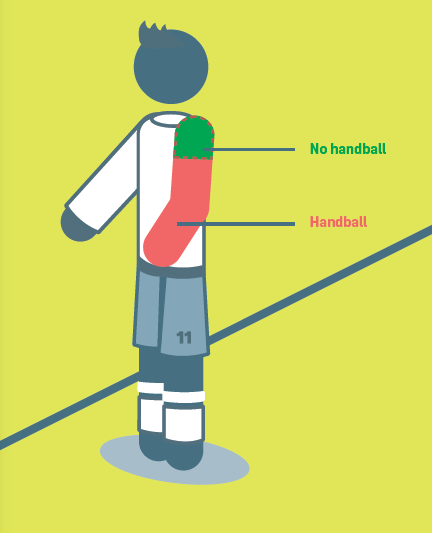
For the purposes of determining handball offences, the upper boundary of the arm is in line with the lesser of the armpit. Not every impact of a player's paw/arm with the ball is an offence.
It is an offence if a thespian:
- deliberately touches the ball with their hand/arm, for example moving the hand/arm towards the ball
- touches the ball with their hand/arm when it has made their body unnaturally bigger. A player is considered to take fabricated their body unnaturally bigger when the position of their hand/arm is not a issue of, or justifiable by, the player'due south trunk movement for that specific situation. Past having their hand/arm in such a position, the player takes a take chances of their manus/arm beingness striking by the ball and being penalised
- scores in the opponents' goal:
- directly from their mitt/arm, fifty-fifty if accidental, including by the goalkeeper
- immediately later on the ball has touched their hand/arm, even if accidental
The goalkeeper has the aforementioned restrictions on treatment the brawl as whatever other histrion outside the penalty area. If the goalkeeper handles the brawl inside their penalty area when non permitted to practise so, an indirect costless kicking is awarded but in that location is no disciplinary sanction. All the same, if the offence is playing the ball a second time (with or without the hand/arm) after a restart before it touches some other player, the goalkeeper must be sanctioned if the offence stops a promising assault or denies an opponent or the opposing team a goal or an obvious goal-scoring opportunity.
Indirect free kick
An indirect gratis boot is awarded if a thespian:
- plays in a unsafe mode
- impedes the progress of an opponent without any contact being fabricated
- is guilty of dissent, using offensive, insulting or abusive linguistic communication and/or action(s) or other exact offences
- prevents the goalkeeper from releasing the ball from the easily or kicks or attempts to boot the ball when the goalkeeper is in the procedure of releasing it
- initiates a deliberate play a trick on for the brawl to be passed (including from a costless kick or goal kick) to the goalkeeper with the head, chest, knee etc. to circumvent the Police, whether or not the goalkeeper touches the ball with the hands; the goalkeeper is penalised if responsible for initiating the deliberate pull a fast one on
- commits any other offence, not mentioned in the Laws, for which play is stopped to caution or send off a player
An indirect gratuitous kick is awarded if a goalkeeper, inside their penalty surface area, commits whatever of the following offences:
- controls the brawl with the hand/arm for more six seconds earlier releasing information technology
- touches the ball with the hand/arm later on releasing it and before information technology has touched another player
- touches the brawl with the mitt/arm, unless the goalkeeper has clearly kicked or attempted to kicking the ball to release it into play, after:
- it has been deliberately kicked to the goalkeeper by a team-mate
- receiving information technology direct from a throw-in taken by a team-mate
A goalkeeper is considered to be in control of the ball with the hand(southward) when:
- the ball is betwixt the hands or between the paw and any surface (due east.g. ground, own trunk) or by touching information technology with any part of the hands or arms except if the ball rebounds from the goalkeeper or the goalkeeper has fabricated a salvage
- holding the ball in the outstretched open hand
- bouncing it on the basis or throwing it in the air
A goalkeeper cannot be challenged by an opponent when in control of the ball with the hand(s).
PLAYING IN A DANGEROUS MANNER
Playing in a dangerous manner is any activity that, while trying to play the ball, threatens injury to someone (including the player themself) and includes preventing a nearby opponent from playing the brawl for fear of injury.
A scissors or bicycle boot is permissible provided that it is non dangerous to an opponent.
IMPEDING THE PROGRESS OF AN OPPONENT WITHOUT CONTACT
Impeding the progress of an opponent ways moving into the opponent'south path to obstruct, block, slow downwardly or force a alter of direction when the ball is not inside playing distance of either player.
All players have a right to their position on the field of play; being in the fashion of an opponent is not the same equally moving into the fashion of an opponent.
A player may shield the brawl by taking a position between an opponent and the brawl if the ball is within playing distance and the opponent is not held off with the artillery or trunk. If the ball is within playing distance, the thespian may be fairly charged by an opponent.
Disciplinary action
The referee has the potency to take disciplinary action from entering the field of play for the pre-match inspection until leaving the field of play later on the lucifer ends (including kicks from the penalty mark).
If, before inbound the field of play at the start of the lucifer, a player or squad official commits a sending-off offence, the referee has the authority to forbid the role player or team official taking office in the match (encounter Law 3.6); the referee will report whatever other misconduct.
A player or squad official who commits a cautionable or sending-off offence, either on or off the field of play, against an opponent, a squad-mate, a lucifer official or whatsoever other person or the Laws of the Game, is disciplined co-ordinate to the offence.
The yellowish card communicates a caution and the red menu communicates a sending-off.
But a player, substitute or substituted player or team official may be shown the red or yellowish carte.
Players, substitutes and substituted players
Delaying the restart of play to prove a carte
Once the referee has decided to circumspection or send off a actor, play must not be restarted until the sanction has been administered, unless the non-offending team takes a quick free kick, has a clear goal-scoring opportunity and the referee has not started the disciplinary sanction procedure. The sanction is administered at the next stoppage; if the offence was denying the opposing team an obvious goal-scoring opportunity, the thespian is cautioned; if the offence interfered with or stopped a promising assail, the role player is not cautioned.
Advantage
If the referee plays the advantage for an offence for which a caution/sending-off would have been issued had play been stopped, this caution/sending-off must exist issued when the brawl is adjacent out of play. However, if the offence was denying the opposing squad an obvious goal-scoring opportunity, the role player is cautioned for unsporting behaviour; if the offence was interfering with or stopping a promising set on, the role player is not cautioned.
Reward should not be practical in situations involving serious foul play, violent bear or a second cautionable offence unless there is a clear opportunity to score a goal. The referee must send off the player when the ball is next out of play but if the player plays the brawl or challenges/interferes with an opponent, the referee volition end play, send off the thespian and restart with an indirect gratuitous kick, unless the player committed a more serious offence.
If a defender starts property an attacker outside the punishment area and continues holding within the penalty area, the referee must award a penalty kicking.
CAUTIONABLE OFFENCES
A player is cautioned if guilty of:
- delaying the restart of play
- dissent by word or action
- entering, re-inbound or deliberately leaving the field of play without the referee'south permission
- failing to respect the required distance when play is restarted with a dropped ball, corner kick, free boot or throw-in
- persistent offences (no specific number or pattern of offences constitutes "persistent")
- unsporting behaviour
- inbound the referee review area (RRA)
- excessively using the 'review' (Television receiver screen) signal
A substitute or substituted player is cautioned if guilty of:
- delaying the restart of play
- dissent by word or activeness
- entering or re-entering the field of play without the referee's permission
- unsporting behaviour
- inbound the referee review area (RRA)
- excessively using the 'review' (Television screen) bespeak
Where two separate cautionable offences are committed (even in close proximity), they should consequence in ii cautions, for instance if a role player enters the field of play without the required permission and commits a reckless tackle or stops a promising attack with a foul/handball, etc.
CAUTIONS FOR UNSPORTING BEHAVIOUR
There are unlike circumstances when a player must be cautioned for unsporting behaviour including if a player:
- attempts to deceive the referee east.g. by feigning injury or pretending to have been fouled (simulation)
- changes places with the goalkeeper during play or without the referee's permission (see Law three)
- commits in a reckless mode a directly free kick offence
- handles the brawl to interfere with or stop a promising attack
- commits any other offence which interferes with or stops a promising assault except where the referee awards a penalisation kick for an offence which was an attempt to play the ball
- denies an opponent an obvious goal-scoring opportunity by an offence which was an attempt to play the ball and the referee awards a penalty kick
- handles the ball in an try to score a goal (whether or not the try is successful) or in an unsuccessful effort to prevent a goal
- makes unauthorised marks on the field of play
- plays the ball when leaving the field of play later existence given permission to go out
- shows a lack of respect for the game
- initiates a deliberate trick for the ball to exist passed (including from a free kicking or goal boot) to the goalkeeper with the head, breast, knee etc. to circumvent the Law, whether or not the goalkeeper touches the ball with the hands; the goalkeeper is cautioned if responsible for initiating the deliberate fox
- verbally distracts an opponent during play or at a restart
Celebration OF A GOAL
Players tin can celebrate when a goal is scored, just the commemoration must non be excessive; choreographed celebrations are non encouraged and must not crusade excessive fourth dimension-wasting.
Leaving the field of play to gloat a goal is non a cautionable offence but players should return every bit soon as possible.
A histrion must be cautioned, even if the goal is disallowed, for:
- climbing onto a perimeter fence and/or approaching the spectators in a mode which causes safety and/or security issues
- gesturing or interim in a provocative, derisory or inflammatory way
- covering the caput or face with a mask or other similar item
- removing the shirt or roofing the caput with the shirt
DELAYING THE RESTART OF PLAY
Referees must caution players who delay the restart of play by:
- appearing to have a throw-in only suddenly leaving it to a team-mate to take
- delaying leaving the field of play when beingness substituted
- excessively delaying a restart
- boot or conveying the ball away, or provoking a confrontation by deliberately touching the ball afterward the referee has stopped play
- taking a costless boot from the wrong position to force a retake
SENDING-OFF OFFENCES
A player, substitute or substituted player who commits any of the post-obit offences is sent off:
- denying the opposing squad a goal or an obvious goal-scoring opportunity by a handball offence (except a goalkeeper inside their penalty area)
- denying a goal or an obvious goal-scoring opportunity to an opponent whose overall motion is towards the offender'south goal by an offence punishable by a free kicking (unless as outlined beneath)
- serious foul play
- biting or spitting at someone
- violent carry
- using offensive, insulting or calumniating language and/or action(due south)
- receiving a second caution in the aforementioned lucifer
- entering the video operation room (VOR)
A player, substitute or substituted role player who has been sent off must leave the vicinity of the field of play and the technical area.
DENYING A GOAL OR AN OBVIOUS GOAL-SCORING OPPORTUNITY
Where a player denies the opposing team a goal or an obvious goal-scoring opportunity by a handball offence the player is sent off wherever the offence occurs.
Where a actor commits an offence against an opponent inside their own punishment surface area which denies an opponent an obvious goal-scoring opportunity and the referee awards a penalty kick, the offending player is cautioned if the offence was an try to play the brawl; in all other circumstances (e.m. holding, pulling, pushing, no possibility to play the ball etc.) the offending player must be sent off.
A histrion, sent-off role player, substitute or substituted player who enters the field of play without the required referee's permission and interferes with play or an opponent and denies the opposing team a goal or an obvious goal-scoring opportunity is guilty of a sending-off offence
The following must be considered:
- distance betwixt the offence and the goal
- general management of the play
- likelihood of keeping or gaining control of the ball
- location and number of defenders
SERIOUS FOUL PLAY
A tackle or claiming that endangers the condom of an opponent or uses excessive force or brutality must be sanctioned every bit serious foul play.
Whatever player who lunges at an opponent in challenging for the ball from the front, from the side or from backside using one or both legs, with excessive force or endangers the safety of an opponent is guilty of serious foul play.
VIOLENT Comport
Violent conduct is when a player uses or attempts to use excessive force or brutality against an opponent when not challenging for the ball, or against a squad-mate, squad official, friction match official, spectator or any other person, regardless of whether contact is made.
In improver, a player who, when non challenging for the brawl, deliberately strikes an opponent or any other person on the head or face with the hand or arm, is guilty of tearing conduct unless the force used was negligible.
Team Officials
Where an offence is committed and the offender cannot be identified, the senior squad autobus present in the technical area will receive the sanction.
WARNING
The following offences should ordinarily issue in a warning; repeated or blatant offences should upshot in a caution or sending-off:
- entering the field of play in a respectful/non-confrontational style
- failing to cooperate with a match official east.g. ignoring an educational activity/request from an assistant referee or the fourth official
- pocket-sized/depression-level disagreement (by word or action) with a decision
- occasionally leaving the confines of the technical area without committing some other offence
Circumspection
Circumspection offences include (but are not express to):
- conspicuously/persistently non respecting the confines of their team's technical area
- delaying the restart of play past their team
- deliberately entering the technical area of the opposing team (non-confrontational)
- dissent by discussion or activity including:
- throwing/kicking drinks bottles or other objects
- action(southward) which show(s) a clear lack of respect for the match official(s) eastward.g.sarcastic clapping
- entering the referee review expanse (RRA)
- excessively/persistently gesturing for a red or yellow card
- excessively showing the Boob tube signal for a VAR 'review'
- gesturing or acting in a provocative or inflammatory style
- persistent unacceptable behaviour (including repeated alarm offences)
- showing a lack of respect for the game
SENDING OFF
Sending-off offences include (but are not limited to):
- delaying the restart of play by the opposing team e.g. holding onto the ball, kick the brawl away, obstructing the motion of a player
- deliberately leaving the technical area to:
- show dissent towards, or remonstrate with, a match official
- act in a provocative or inflammatory style
- enter the opposing technical area in an aggressive or confrontational way
- deliberately throwing/kicking an object onto the field of play
- entering the field of play to:
- confront a match official (including at half-time and full-time)
- interfere with play, an opposing player or a match official
- entering the video operation room (VOR)
- physical or ambitious behaviour (including spitting or bitter) towards an opposing histrion, substitute, team official, match official, spectator or any
other person (e.g. brawl boy/daughter, security or competition official etc.) - receiving a 2nd caution in the same friction match
- using offensive, insulting or calumniating language and/or activeness(s)
- using unauthorised electronic or communication equipment and/or behaving in an inappropriate mode every bit the effect of using electronic or communication equipment
- vehement carry
OFFENCES WHERE AN OBJECT (OR THE Ball) IS THROWN
In all cases, the referee takes the appropriate disciplinary action:
- reckless – caution the offender for unsporting behaviour
- using excessive force – ship off the offender for fierce conduct.
Restart of play after fouls and misconduct
If the brawl is out of play, play is restarted according to the previous decision If the ball is in play and a player commits a concrete offence inside the field of play against:
- an opponent – indirect or direct free kicking or punishment kick
- a squad-mate, substitute, substituted or sent-off player, team official or a match official – a direct free kick or penalization kicking
All verbal offences are penalised with an indirect gratuitous boot.
If the referee stops play for an offence committed past a player, inside or outside the field of play, against an exterior agent, play is restarted with a dropped ball, unless a free kick is awarded for leaving the field of play without the referee's permission.
If, when the ball is in play:
- a player commits an offence confronting a friction match official or an opposing role player, substitute, substituted or sent-off player, or team official outside the field of play or
- a substitute, substituted or sent-off player, or team official commits an offence against, or interferes with, an opposing player or match official outside the field of play,
play is restarted with a gratis kick on the boundary line nearest to where the offence/interference occurred; for straight free kicking offences, a penalty kicking is awarded if this is a direct gratuitous kick offence within the offender's penalty area
If an offence is committed exterior the field of play past a player against a actor, substitute, substituted player or team official of their ain squad, play is restarted with an indirect free kick on the purlieus line closest to where the offence occurred.
If a player makes contact with the ball with an object (boot, shinguard etc.) held in the hand play is restarted with a direct free boot (or penalization kick).
If a player who is on or off the field of play throws or kicks an object (other than the friction match ball) at an opposing player, or throws or kicks an object (including a ball) at an opposing substitute, substituted or sent-off thespian, team official, or a friction match official or the match ball, play is restarted with a straight free kicking from the position where the object struck or would have struck the person or the ball. If this position is off the field of play, the free kick is taken on the nearest point on the boundary line; a punishment kick is awarded if this is inside the offender's penalty area.
If a substitute, substituted or sent-off player, actor temporarily off the field of play or team official throws or kicks an object onto the field of play and it interferes with play, an opponent or match official, play is restarted with a direct free boot (or penalty kick) where the object interfered with play or struck or would have struck the opponent, match official or the brawl.

Source: https://www.thefa.com/football-rules-governance/lawsandrules/laws/football-11-11/law-12---fouls-and-misconduct
Posted by: lupientorty1994.blogspot.com
0 Response to "How To Draw Fouls In Fifa 19"
Post a Comment